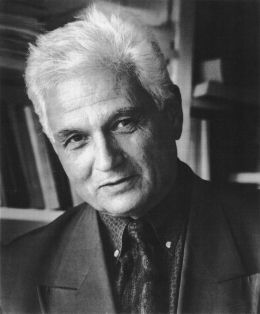
Jacques Derrida

- Of Grammatology (1967)
- Writing and Difference (1967)
- Dissemination (1972)
- The Post Card (1980)
- Specters of Marx (1993)
Jacques Derrida (1930–2004) was a French philosopher best known for founding the critical method of deconstruction. Though not a clinician or analyst, Derrida’s sustained engagement with Sigmund Freud and Jacques Lacan placed him at the center of 20th-century debates about the status of psychoanalysis within philosophy, language, and politics. His deconstructive approach to the unconscious, writing, and presence helped articulate post-structuralist critiques of metaphysics and influenced numerous psychoanalytic and post-psychoanalytic theorists.
Derrida’s challenge to traditional psychoanalysis centered on the status of the unconscious, which he reimagined not as a hidden repository of repressed content, but as a differential structure of traces, gaps, and deferrals. His theoretical vocabulary—including terms such as différance, iterability, and supplementarity—has become essential to contemporary debates on interpretation, trauma studies, and the ethics of the clinical encounter. In his hands, psychoanalysis became a hermeneutic practice attentive to the "scene of writing" rather than the recovery of an original, self-present truth.[1]
1. Intellectual Biography
1.1 Early Life and Colonial Marginalization
Jacques Derrida was born on July 15, 1930, in El-Biar, Algeria, into a Sephardic Jewish family. His early life was marked by the trauma of institutional exclusion; in 1942, under the antisemitic policies of the Vichy regime, he was expelled from his lycée. This experience of being "cast out" from the symbolic order of French citizenship while living in a colonial context became a cornerstone of his later thinking on law, the archive, and the "Marrano" status of the subject—one whose identity is never fully self-present but always mediated by an external and often hostile authority.[2]
In 1949, Derrida moved to France to study at the École Normale Supérieure (ENS), where he came under the tutelage of Louis Althusser. Initially specializing in the phenomenology of Edmund Husserl, Derrida’s early work sought to deconstruct the ideal of "living presence," arguing instead that even the most intimate self-consciousness is mediated by an "essential exteriority" or inscription.
1.2 The "Grammatological" Turn
The year 1967 marked Derrida's definitive entry into psychoanalytic relevance with the publication of three landmark texts: Of Grammatology, Writing and Difference, and Speech and Phenomena. These works collectively dismantled the privileging of speech over writing (logocentrism), a move that had immediate consequences for the psychoanalytic understanding of the "talking cure." By arguing that the "trace" precedes the spoken word, Derrida repositioned the unconscious as a "text" that is always already being written and rewritten, rather than a voice seeking to be heard.[3]
2. Deconstruction and the Freudian Metapsychology
2.1 The Scene of Writing and the Wunderblock
Derrida’s most sustained engagement with Sigmund Freud appears in his 1966 essay, "Freud and the Scene of Writing." Derrida argues that Freud’s greatest discovery was not a specific content of the mind, but a new model of psychic "inscription." He focuses particularly on Freud’s 1925 paper, "A Note upon the Mystic Writing-Pad" (Wunderblock), in which Freud uses a children’s toy as a metaphor for the psychic apparatus.[4]
Derrida radicalizes this metaphor, suggesting that the psyche does not merely use writing; it is a writing machine. He challenges the traditional "archaeological" model of psychoanalysis, which views the analyst as an excavator digging for a buried, original "truth." For Derrida, there is no "original" event that exists before it is inscribed; the "event" is only constituted through its inscription and subsequent transcriptions across different psychic registers.
2.2 Nachträglichkeit and Différance
Derrida identifies Freud’s concept of Nachträglichkeit (deferred action or afterwardness) as a crucial precursor to his own concept of différance. In Freud’s work, an experience often acquires traumatic force only retroactively, when re-contextualized by a later event. Derrida argues that this disrupts the "metaphysics of presence" because it suggests that the "origin" of a symptom is never a single, present moment but a temporal delay.[5] In this framework, repression is not the hiding of a secret, but the "over-writing" of one trace by another, creating a chain of signifiers that never reaches a final, stable signified.
3. Derrida and Lacan: The Conflict of the Symbolic
3.1 The 1966 Johns Hopkins Conference
The relationship between Derrida and Jacques Lacan is characterized by a "missed encounter" that catalyzed the shift from structuralism to post-structuralism. At the 1966 Baltimore conference, "The Languages of Criticism and the Sciences of Man," Derrida delivered his pivotal lecture, "Structure, Sign, and Play." While Lacan claimed to decenter the subject through the symbolic order, Derrida argued that Lacanian theory merely replaced the "conscious ego" with a new metaphysical center: the Phallus or the Name-of-the-Father.[6]
3.2 Phallogocentrism and the Postal Principle
Derrida coined the term "phallogocentrism" to describe what he saw as Lacan's reliance on a "transcendental signifier" to anchor meaning. In his essay "The Purveyor of Truth" (collected in The Post Card), Derrida deconstructs Lacan’s reading of Edgar Allan Poe’s "The Purloined Letter." Where Lacan asserted that "a letter always arrives at its destination," meaning the symbolic position of the signifier dictates the subject's fate, Derrida introduced the "Postal Principle."[7]
Derrida argued that signifiers are essentially prone to being lost, diverted, or "misdelivered." For Derrida, the structural possibility that a message might not arrive—that meaning might fail or that transference might remain unresolved—is the very condition of language and desire. To claim a letter "always" arrives is, for Derrida, to reinstate a "theological" certainty within the heart of psychoanalysis.
4. Late Metapsychology: Archive and Drive
4.1 Archive Fever and the Death Drive
In his 1994 lecture at the Freud Museum in London, later published as Archive Fever: A Freudian Impression (Mal d'Archive), Derrida turned his attention to the relationship between technology, memory, and the death drive. He argues that the archive is not merely a place of preservation, but an institutionalizing force that produces the very events it purports to record. Derrida links this "fever" or "pain" (mal) of the archive to Freud's late metapsychology in Beyond the Pleasure Principle.[8]
Derrida identifies a structural contradiction in the archive: the impulse to preserve memory is inseparable from the death drive (Todestrieb), which he describes as "archiviolithic"—a force that works to destroy the trace, the memory, and the archive itself. For Derrida, the death drive is "silent"; it leaves no trace of its own, but manifests as a compulsion to erase. Consequently, the more an institution (or a psyche) seeks to secure its memory through external inscriptions, the more it testifies to the radical loss of the original experience.[9]
4.2 From Archeology to Archiviology
Derrida’s archival turn challenged the traditional psychoanalytic view of the unconscious as a buried "archeological" site. If the archive (and the unconscious) is governed by the death drive, then the analyst is not an archeologist recovering a lost truth, but an "archiviologist" participating in a "technical" production of the past. In the analytic encounter, the "history" of the patient is not found in the archive of the unconscious; rather, the analytic setting itself creates the conditions under which that history is archived and made legible.[10]
5. Intellectual Associations and "Derridean Psychoanalysis"
Derrida’s impact on the clinical field was mediated through his close proximity to a generation of analysts who sought to move beyond the schisms of the International Psychoanalytical Association (IPA) and the Lacanian schools.
5.1 Jean Laplanche: Translation and the Enigmatic Signifier
One of the most significant theoretical convergences in twentieth-century psychoanalysis occurred between Derrida and Jean Laplanche. Laplanche’s "general theory of seduction" posits that the unconscious is formed through the infant’s attempt to "translate" the "enigmatic signifiers" transmitted by the adult Other. These signifiers are "enigmatic" because they are imbued with the adult's own unconscious desire, which the adult cannot fully understand or control.[11]
Derrida’s concepts of différance and the "failed translation" provided Laplanche with the philosophical framework to describe the unconscious not as a repository of biological drives, but as a "remainder" of a failed communicative act. For both thinkers, the subject is constitutively divided by an "otherness" that can never be fully mastered or integrated into self-consciousness. This collaboration reoriented psychoanalysis toward an ethics of the message and the "trace" of the Other.[12]
5.2 Abraham, Torok, and the Theory of the Crypt
Derrida played a vital role in the reception of the work of Nicolas Abraham and Maria Torok. In his lengthy 1976 preface, titled "Fors," to their book The Wolf Man’s Magic Word, Derrida elaborated on their distinction between "introjection" and "incorporation." While introjection is the healthy psychic assimilation of a lost object, "incorporation" occurs when the loss is refused, leading to the creation of a "Crypt" within the ego.[13]
The Crypt is a secret psychic vault where a traumatic secret—often a secret belonging to a previous generation—is "buried alive." Derrida found in this clinical model a powerful analogue for his own theory of the trace. This led to the development of the theory of "transgenerational trauma" (the "Phantom"), where the unspoken repressions of the parents haunt the psychic life of the child. This "hauntological" dimension of psychoanalysis remains one of Derrida’s most enduring clinical legacies.[14]
5.3 Sarah Kofman and the Rhetoric of Freud
Sarah Kofman, a philosopher and student of Derrida, applied deconstructive strategies to the aesthetic and figurative dimensions of Freud’s writing. In works such as Freud and Fiction (1970) and The Enigma of Woman (1980), Kofman demonstrated that Freud's metapsychology was inextricably bound to literary tropes and metaphors. Like Derrida, Kofman argued that the "truth" of psychoanalysis cannot be separated from the "writing" of its founder, thereby exposing the internal resistances and aporias within Freud’s own theories of femininity and art.[15]
6. Ethics: Mourning and Hospitality
6.1 Interminable Mourning vs. Introjection
Derrida’s later work radicalized Freud’s distinction between mourning and melancholia. In Freud’s 1917 essay, "successful" mourning (introjection) involves the libidinal withdrawal from the lost object, allowing the subject to move on. Derrida, conversely, argues in The Work of Mourning (2001) that Freud’s model of successful mourning is a form of secondary violence—a "consumption" of the other that effaces their alterity.[16]
For Derrida, the only ethical mourning is "impossible" or "failed" mourning (incorporation). To keep the other alive as a "trace" within oneself, without attempting to assimilate or "overcome" their loss, is for Derrida the condition of hospitality. In a clinical context, this suggests that the goal of analysis is not to "resolve" grief or trauma, but to sustain a relation to the ghost of the other that respects its irreducible difference.[17]
6.2 The Ethics of the Analytic Scene
Derrida’s concept of "unconditional hospitality"—the openness to the Other without prior knowledge or mastery—has been used to rethink the posture of the psychoanalyst. Derrida argues that the analyst must welcome the patient’s speech as an "absolute arrival" (arriving), resisting the temptation to immediately categorize it within a pre-existing diagnostic archive. This mirrors the Freudian rule of evenly-suspended attention, but Derrida elevates it to a radical ethical imperative: the analyst must host the "monstrous" and the "un-decidable" in the patient’s narrative, acknowledging that the unconscious is a message that can never be fully "delivered" or deciphered.[18]
7. Critical Reception and Controversies
7.1 The Lacanian Critique: Textualism and the Real
Derrida’s reception within the Lacanian school has been historically contentious, centering on the charge of "textualism." Jacques-Alain Miller, the primary editor of Lacan's seminars, argued that Derrida’s focus on the "letter" and the instability of meaning dissolved the clinical specificity of psychoanalysis into a branch of literary criticism.[19]
Slavoj Žižek has extended this critique from a Lacano-Hegelian perspective, arguing that deconstruction remains at the level of the "symbolic" and "imaginary" and fails to confront the traumatic kernel of the Real. For Žižek, Derrida's emphasis on deferral (différance) functions as a "defense" against the encounter with jouissance—the painful pleasure that drives the symptom. Žižek contends that whereas psychoanalysis seeks a "forced choice" in the clinic, deconstruction remains in a state of "infinite undecidability" that risks political and therapeutic paralysis.[20]
7.2 Clinical Resistance and Meta-Psychoanalysis
Some clinical practitioners have argued that Derrida’s rejection of foundational meaning undermines the task of "working through" (Durcharbeitung). If every interpretation is merely a further inscription without a final referent, these critics ask, what becomes of the resolution of the transference?[21]
Derrida responded to these charges in Resistances of Psychoanalysis (1996). He argued that he was not "critiquing" psychoanalysis from the outside, but rather analyzing the "resistances" that psychoanalysis poses to itself. He suggested that both deconstruction and psychoanalysis are unified by an interest in that which cannot be formalized or "totalized" within a system of knowledge.[22]
8. Legacy and Continuing Relevance
8.1 Trauma Studies and the Unassimilable Trace
Derrida’s work on the "unassimilable trace" and the aporias of memory has been a foundational pillar for contemporary trauma theory. Thinkers such as Cathy Caruth and Shoshana Felman have used Derridean concepts to describe trauma not as a past event that can be "remembered," but as an experience that is "missed" and only returns through repetitive, ghostly hauntings. This has shifted the psychoanalytic study of trauma toward a "hauntological" model, where the subject is defined by their relation to an unrepresentable loss.[23]
8.2 Feminist and Queer Theory: Deconstructing Phallogocentrism
By deconstructing "phallogocentrism," Derrida provided the theoretical framework for Judith Butler’s theory of performativity. Butler’s argument that gender is not a stable identity but a repetitive "citation" of symbolic norms is a direct application of Derrida’s theory of iterability. This has allowed queer and feminist psychoanalysts to interrogate the "inevitability" of the Oedipal structure and the symbolic law of the father, opening the field to new understandings of non-normative desire and embodiment.[24]
8.3 Postcolonial Psychoanalysis
Derrida's own status as a "hyphenated" subject (Algerian-Jewish-French) has inspired a "decolonial" psychoanalysis. His critique of Western metaphysics as a history of "sovereignty" has been used to analyze the unconscious dimensions of colonial violence and the "phantom" traces of ancestral displacement in refugee and migrant populations.[25]
9. Key Works in Psychoanalysis
- "Freud and the Scene of Writing" (1966): The foundational essay connecting the unconscious to a "writing machine" and the logic of the trace.
- Writing and Difference (1967) – Contains essays engaging Freud and phenomenology; introduces early deconstructive techniques.
- Of Grammatology (1967) – Foundational text of deconstruction; critiques logocentrism and introduces différance.
- "The Purveyor of Truth" (1975): A definitive deconstruction of Lacanian structuralism and the "Postal Principle."
- "The Post Card: From Socrates to Freud and Beyond" (1980): An experimental exploration of filiation, transmission, and the failure of the letter to arrive at its destination.
- "Archive Fever: A Freudian Impression" (1995): A meditation on the archive, the death drive, and the impossibility of preserving a pure memory.
- "Resistances of Psychoanalysis" (1996): Includes Derrida’s reflections on the limits and futures of psychoanalysis.
See also
- Deconstruction
- Différance
- Trace (deconstruction)
- Nachträglichkeit
- Jean Laplanche
- Phallogocentrism
- Hauntology
Notes
- ↑ Roudinesco, E. (2001). Derrida and Psychoanalysis. In: Philosophy in a Time of Terror. University of Chicago Press.
- ↑ Derrida, J. (1991). Circumfession. In: Bennington, G., Jacques Derrida. University of Chicago Press.
- ↑ Spivak, G. C. (1976). Translator's Preface to Derrida’s Of Grammatology. Johns Hopkins University Press.
- ↑ Freud, S. (1925). "A Note upon the Mystic Writing-Pad." Standard Edition, Vol. 19.
- ↑ Derrida, J. (1978). "Freud and the Scene of Writing." In: Writing and Difference. University of Chicago Press, pp. 196-231.
- ↑ Macksey, R., & Donato, E. (1970). The Structuralist Controversy: The Languages of Criticism and the Sciences of Man. Johns Hopkins University Press.
- ↑ Derrida, J. (1980). The Post Card: From Socrates to Freud and Beyond. Trans. Alan Bass. University of Chicago Press.
- ↑ Derrida, J. (1995). Archive Fever: A Freudian Impression. Trans. Eric Prenowitz. University of Chicago Press.
- ↑ Steedman, C. (2001). Dust: The Archive and Cultural History. Rutgers University Press. [Critique of Derrida's archival logic].
- ↑ Manoff, M. (2004). "Theories of the Archive from Across the Disciplines." Libraries and the Academy, 4(1), pp. 9-25.
- ↑ Laplanche, J. (1999). Essays on Otherness. Routledge.
- ↑ Fletcher, J. (2013). Reading Laplanche. ICA Press.
- ↑ Abraham, N., & Torok, M. (1986). The Wolf Man's Magic Word: A Cryptonymy. Preface by Jacques Derrida. University of Minnesota Press.
- ↑ Bennington, G. (1993). Jacques Derrida. University of Chicago Press, p. 250 [on the logic of the Crypt].
- ↑ Kofman, S. (1985). The Enigma of Woman: Woman in Freud's Writings. Cornell University Press.
- ↑ Derrida, J. (2001). The Work of Mourning. Eds. Pascale-Anne Brault and Michael Naas. University of Chicago Press.
- ↑ Bennington, G. (2000). Interrupting Derrida. Routledge [on the ethics of the trace].
- ↑ Derrida, J. (2000). Of Hospitality. Trans. Rachel Bowlby. Stanford University Press.
- ↑ Miller, J.-A. (1994). "Discussion on Derrida." Journal of the Centre for Freudian Analysis and Research, 4, pp. 3–11.
- ↑ Žižek, S. (1989). The Sublime Object of Ideology. Verso, pp. 153–158.
- ↑ Green, A. (2005). The Illusion of Common Sense. Free Association Books. [Critique of post-structuralism in the clinic].
- ↑ Derrida, J. (1996). Resistances of Psychoanalysis. Trans. Peggy Kamuf et al. Stanford University Press.
- ↑ Caruth, C. (1996). Unclaimed Experience: Trauma, Narrative, and History. Johns Hopkins University Press.
- ↑ Butler, J. (1990). Gender Trouble: Feminism and the Subversion of Identity. Routledge.
- ↑ Khanna, R. (2003). Dark Continents: Psychoanalysis and Colonialism. Duke University Press.