Real

Originator
Systematic elaboration
Interdisciplinary application
Clinical extension
Interdisciplinary application
Theoretical opposition
Mutual constitution
Foundational dependency
Elaborates-refines
Foundational
Elaborates
Elaborates
Clinical manifestation
Clinical application
Theoretical evolution
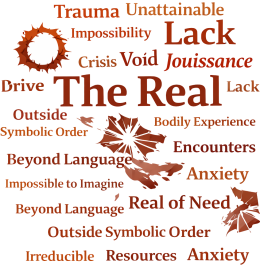
The Real (le réel) is one of the three fundamental registers of human experience in the psychoanalytic theory of Jacques Lacan, distinguishing it from the Symbolic (le symbolique) and the Imaginary (l'imaginaire). Together, these three orders—often abbreviated as the RSI triad—form the structural topography of the subject in Lacanian psychoanalysis. While the Imaginary governs the realm of images, identification, and the ego, and the Symbolic encompasses the domain of language, the law, and the social order, the Real designates that which is categorically impossible to symbolize. It is the register of that which is expelled from reality, resisting integration into the signifying chain, yet insisting as a traumatic point of rupture.
Lacan formally defines the Real not as a synonym for external, empirical reality (la réalité), but as its radical limit. In his seminal Seminar XI, he asserts that "the Real is the impossible," meaning it is structurally impossible to imagine or symbolize fully.[1] It is the state of nature from which the subject has been severed by their entrance into language; it is the "absolute fullness" that knows no lack, no absence, and no negativity, yet can only be encountered by the speaking subject as a traumatic void or an overwhelming excess.
The Real is that which always comes back to the same place—to the place where the subject in so far as he thinks, where the res cogitans, does not meet it.[1]
The concept of the Real evolved significantly throughout Lacan's teaching. In the 1930s and 1940s, the term was used relatively loosely to refer to material facts or the external world. However, by the 1950s, with Lacan’s "return to Freud" and the application of structural linguistics to psychoanalysis, the Real took on its technical status as the "foreclosed" element of the Symbolic order. By the late period of Lacan's work (the 1970s), the Real moved from a peripheral boundary concept to the central knot of the subjective structure, increasingly associated with jouissance (excessive enjoyment), the Borromean knot, and the sinthome.
Understanding the Real is essential for grasping the Lacanian approach to clinical practice, particularly regarding trauma, psychosis, and the limits of interpretation. Unlike the "reality principle" of ego psychology, which seeks to adapt the patient to the external world, Lacanian psychoanalysis aims to confront the subject with the Real of their desire—the irreducible kernel of non-meaning that structures their existence.
Conceptual Origins and Early Formulations (1930s-1950s)
The trajectory of "the Real" in Lacan's work is not linear; it undergoes a profound metamorphosis from a phenomenological descriptor of "what is" to a structuralist category of "what is missing." To understand the mature concept of the Real as the "impossible," one must trace its emergence from Lacan’s early psychiatric writings, where it was not yet distinguished rigorously from the concept of reality.
Emergence of the Term
In Lacan’s writings of the 1930s and 1940s, the term "real" appears frequently but lacks the capitalization and specific theoretical weight it would later acquire. In his doctoral thesis, De la psychose paranoïaque dans ses rapports avec la personnalité (1932), Lacan operates largely within the framework of Jaspersian phenomenology and standard psychiatry. Here, "the real" often refers to the concrete facts of the patient's situation or the external world as opposed to the patient's delusions.
During this period, Lacan was deeply influenced by the surrealist movement and the philosophy of Spinoza, which posited a certain fullness to the natural world. In these early formulations, the real is simply that which exists outside the mind—the raw data of existence before it is processed by perception. It is the "given" of experience. However, traces of the later concept appear in his engagement with the "Papin Sisters" case, where Lacan notes a "paranoiac structure" that blurs the line between the internal drive and external act, suggesting a dimension of experience that ruptures the continuity of the ego's reality.[2]
The crucial turning point occurs in the early 1950s, specifically with the commencement of his public seminars. In Seminar I (1953–1954), Lacan begins to triangulate the Real against the Symbolic and the Imaginary, though the Real is initially the least developed of the three. At this stage, he often describes the Real as "absolute fullness" or "plenum"—a continuous mass without fissures, gaps, or lack.
The real is without fissure. [...] It is the symbolic which introduces the cut, the break, the opening, into the real.[3]
In this early structuralist phase, the Real is defined primarily by what it is not. It is that which has not yet been symbolized. It is the "matter" that the "form" of the Symbolic carves up. Lacan draws here on the Hegelian dialectic of the master and slave (via Alexandre Kojève), positioning the Real as the raw immediacy of life that must be negated by the concept (the word) for human subjectivity to emerge.
The Real vs. Reality
A foundational distinction in Lacanian theory—one that serves as a prerequisite for understanding the register of the Real—is the difference between the Real (le réel) and reality (la réalité). In common parlance and distinct philosophical traditions (such as empiricism), these terms are synonymous. For Lacan, they are structural opposites.
Reality is a construct. It is the stabilized, intelligible world we inhabit, stitched together by the interplay of the Imaginary (which provides the illusion of wholeness and ego-consistency) and the Symbolic (which provides the laws, language, and social structures that organize meaning). Reality is synonymous with the "human world" or "psychical reality"—it is a fantasy frame that protects the subject from the chaos of the drives and the void of existence. As Lacan states in Seminar II:
Reality is grounded in the symbolic... symbolic interchange is what links human beings to each other, that is, it constitutes the essential part of reality.[4]
The Real, by contrast, is that which creates a glitch in this construct. It is the point of failure in the fantasy of reality. If reality is a stage set, the Real is the structural beam that falls and crushes the actor, or the sudden, inexplicable noise from backstage that disrupts the play. The Real is "excluded" from reality; it is the trauma that reality attempts to mask.
Lacan clarifies that while reality possesses a "grimace" of meaning, the Real is utterly senseless. It has no meaning because meaning is a property of the Symbolic order. The Real simply is. This distinction allows Lacan to reinterpret Freud’s distinction between Realität (psychic reality) and Wirklichkeit (material actuality). For Lacan, the Real is the traumatic kernel of Wirklichkeit that resists being metabolized into the Realität of the psychic apparatus.
The real is what resists symbolization absolutely. In the last analysis, it is the place where the symbolic order fails.[3]
This formulation marks the definitive separation of the Lacanian Real from the Kantian noumenon (the thing-in-itself). While the noumenon is an unknowable object behind the phenomenon, the Lacanian Real is an internal fracture within the phenomenon of subjectivity itself—an "internal foreignness" or extimacy (extimité) that constitutes the subject through its very exclusion.
Philosophical Context
The genesis of Lacan's concept of the Real cannot be understood in isolation from the philosophical currents that dominated French intellectual life in the mid-20th century. While Lacan insisted that psychoanalysis is not a philosophy, his theoretical architecture was profoundly shaped by his engagement with Hegel, Heidegger, and the rigorous rereading of Freud.
Central to Lacan's early formulation of the Real is the influence of Alexandre Kojève, whose legendary seminars on Hegel's Phenomenology of Spirit Lacan attended in the 1930s. Kojève emphasized the role of negation in the dialectic of master and slave. For Lacan, this translated into the linguistic operation of the symbol: the word is the "murder of the thing."[5] In order for an object to be conceptualized or named (entered into the Symbolic), its immediate, material particularity must be negated. The Real, in this Hegelian lineage, is the vital, immediate existence that is lost or "killed" the moment the subject speaks.
Thus the symbol manifests itself first of all as the murder of the thing, and this death constitutes in the subject the eternalization of his desire.[5]
Simultaneously, Lacan drew heavily on phenomenology, particularly the work of Heidegger. The Lacanian Real shares a conceptual affinity with the "earth" in Heidegger’s "The Origin of the Work of Art"—that which resists the "worlding" of the world, the concealed substrate that refuses to come into the open clearing of truth (aletheia). It also resonates with Sartre's en-soi (being-in-itself), the brute, inert existence that lacks the nothingness of consciousness (pour-soi). However, Lacan diverges from Sartre by locating this inert resistance not just in the external world, but within the psychic apparatus itself.
Most crucially, Lacan roots the Real in specific Freudian concepts that defied the "pleasure principle" and the smooth functioning of the ego. He returns repeatedly to Freud's Project for a Scientific Psychology (1895) and the concept of das Ding (the Thing). In Freud's analysis of the Nebenmensch (the fellow human complex), the object is split: one part is recognizable and assimilable (the Symbolic/Imaginary attributes), while another part remains alien, unalterable, and traumatic. This remainder is the prototype of the Lacanian Real.[6]
Furthermore, the Real provides the structural explanation for Freud’s Nachträglichkeit (deferred action) and trauma. For Freud, trauma is not inherent in an event but in its inability to be integrated into the psychic chain of associations. Lacan radicalizes this: the traumatic event is Real precisely because it resists symbolization. It is an encounter that bypasses the "defensive shield" of the Symbolic, lodging itself as a foreign body that the psyche repeatedly circles but can never fully digest. This connects the Real to the Uncanny (das Unheimliche)—that which is intimately familiar yet terrifyingly alien because it marks the return of something that ought to have remained hidden.
The Real as Register: The Triadic Schema (1950s-1960s)
By the mid-1950s, Lacan had formalized his teaching around the interaction of three distinct orders: the Real, the Symbolic, and the Imaginary (RSI). This triadic schema moved the Real from a vague philosophical notion of "plenum" or "nature" to a precise structural function within the psychoanalytic field. It is in this period that the Real is rigorously defined by its negative relationship to the signifier.
The Three Registers: RSI
The "return to Freud" that Lacan inaugurated was structurally organized around the RSI triad. While the Imaginary had been the focus of his earlier work on the Mirror Stage, and the Symbolic became the dominant concern of the early 1950s with the influence of Lévi-Strauss and Saussure, the Real was established as the necessary third term that anchored the other two.
In Seminar I (Freud's Papers on Technique), Lacan introduces the registers as essential distinct dimensions of subjective experience. The Imaginary is the realm of the ego, surface appearances, and dual relationships (narcissism, rivalry). The Symbolic is the realm of the unconscious, the Other, and the pact of speech. The Real, initially, is portrayed as that which is "outside" the analytic experience—the biological or physical substrate that analysis does not touch directly but which supports the subject.
The real is what resists symbolization absolutely. [...] The real is without fissure. We don't have to deal with it [in analysis], except to the extent that it's what the subject is stuck in.[3]
However, Lacan quickly complicates this. He posits that the three registers are knotted together. The breakdown of one register inevitably affects the others. For example, in psychosis, the foreclosure of a key Symbolic element (the Name-of-the-Father) causes a catastrophic collapse of the Imaginary, leaving the subject overwhelmed by the Real (hallucinations). Thus, the Real is not merely "nature" outside the mind; it is a structural necessity within the psychic economy, representing the limits of the mental apparatus.
The Real and Symbolization
The defining characteristic of the Real in this period is its exclusion from the Symbolic order. If the Symbolic is a network of signifiers that generates meaning through difference (a is not b), the Real is that which does not differentiate. It is the "impossible" limit of the signifying chain.
Lacan argues that the Symbolic cuts into the Real. The moment a sensation, a drive, or an object is named, it is "mortified"—it loses its living, chaotic immediacy and becomes a fixed element in a system of meaning. The Real is the remainder or leftover of this operation. It is what drops out when the Symbolic net is cast over the world.
The real is the impact of the symbolic on the body. [...] It is the hole in the symbolic order.[4]
This relationship is crucial for understanding the Lacanian conception of the Unconscious. The unconscious is "structured like a language," belonging to the Symbolic. But the nucleus of the unconscious—the navel of the dream, as Freud called it—dips into the Real. It is the point where the signifying chain stops, where words fail. This "impossible-to-symbolize" is not a passive void; it exerts a pressure. The Real insists. It manifests in slips of the tongue, in the repetition of symptoms, and in the "missed encounters" of daily life.
The Real and the Imaginary
While the Symbolic and the Real are structurally opposed (meaning vs. non-meaning), the relationship between the Imaginary and the Real is one of deceptive screening. The Imaginary functions primarily to screen the subject from the raw, traumatic intensity of the Real.
The ego, constructed in the Mirror Stage, offers a sense of wholeness and mastery. It presents the body as a unified "gestalt." The Real, however, corresponds to the fragmented body (corps morcelé)—the chaotic, uncoordinated experience of the drives and the flesh before the mirror's unification. When the Imaginary screen cracks—in moments of extreme anxiety, depersonalization, or psychosis—the Real shines through as the fragmented body or the uncanny double.
The real is beyond the automaton, the return, the coming back, the insistence of the signs, by which we see ourselves governed by the pleasure principle. The real is that which always lies behind the automaton.[1]
Lacan illustrates this with the optical models in Seminar I. The Imaginary provides the "virtual image" that allows the subject to function. But if one moves outside the specific focal point of the Symbolic (the law, the name), the image dissolves, and one is left with the Real: a terrifying, unmediated presence that disrupts the coherence of the self. The Real is thus the "noise" that the Imaginary image attempts to filter out into a clear signal.
Seminar VII: Ethics, the Thing, and the Real (1959-1960)
The academic year of 1959–1960 marked a decisive pivot in Jacques Lacan's teaching. In The Seminar of Jacques Lacan, Book VII: The Ethics of Psychoanalysis, Lacan moved beyond the structuralist supremacy of the Symbolic and the intersubjective dialectic of recognition. Instead, he began to probe the dark, gravitational center around which the Symbolic order orbits. This center is the Real, articulated here through the Freudian concept of das Ding (the Thing). In this seminar, the Real is no longer merely a "glitch" in symbolization but the ethical core of the psychoanalytic subject—a zone of absolute prohibition, transgression, and lethal enjoyment.
Das Ding (The Thing)
To conceptualize the Real in its relation to the drive and the moral law, Lacan recuperates a specific term from Sigmund Freud’s early, unpublished manuscript, Project for a Scientific Psychology (1895): Das Ding ("The Thing"). Lacan distinguishes das Ding from die Sache (the thing as a word-presentation or representable object) and der Gegenstand (the object of perception).
Das Ding is the absolute, prehistoric Other. It represents the primordial object of satisfaction—archetypally the mother—that the subject must permanently lose in order to enter the Symbolic order. It is the "dumb reality" that is fundamentally unknowable, standing outside the chain of signifiers.
The Thing is that which in the real, the primordial real, I will say, suffers from the signifier. This is a crucial definition. It is clearly what is usually the most obscure part of our theoretical development.[6]
Lacan locates das Ding at the center of the psychic topography, yet describes it as extimate (extime)—a neologism combining "exterior" and "intimate." The Thing is the most intimate core of the subject, yet it is radically foreign to the subject's self-understanding. It is a "vacuole," a void around which the Symbolic chain spins. Because das Ding is the site of an absolute fullness that precedes the "cut" of language, it is also the site of the incestuous object. The Symbolic Law (the prohibition of incest) is structural: it keeps the subject at a safe distance from das Ding, for to return to the Thing would be to dissolve the subject in a psychotic or lethal fusion.
Thus, the Real acquires a topology in Seminar VII: it is the central hole in the donut (torus) of reality. The Symbolic order circulates around this hole but can never fill it. The Real is the "beyond-of-the-signified."
Jouissance and the Real
The introduction of das Ding allows Lacan to formalize the concept of Jouissance (enjoyment) and its intricate relationship to the Real. In this period, Lacan strictly distinguishes jouissance from the Pleasure Principle.
Following Freud's Beyond the Pleasure Principle, Lacan argues that the pleasure principle functions as a homeostatic mechanism, regulating tension to a low, stable level. It belongs to the Symbolic and Imaginary registers, ensuring the subject's coherence and survival. Jouissance, however, lies "beyond" this limit. It is the intense, transgressive, and often painful satisfaction derived from encroaching upon the Real. It is the suffering that the subject refuses to give up.
Jouissance is evil. [...] It is the suffering that derives from the satisfaction of the drive.[6]
The Real is the "field" or "reservoir" of jouissance. The Symbolic Law (the Ten Commandments, the social pact) cuts the subject off from this raw enjoyment. Paradoxically, however, the Law creates the desire for transgression. By prohibiting access to the Thing (the incestuous Real), the Law elevates the Thing to the status of the ultimate, coveted Good. Lacan famously references Saint Paul's Epistle to the Romans to illustrate this: "I had not known sin, but by the law." The prohibition creates the dimension of the Real as that which is fiercely desired precisely because it is impossible and forbidden.
In this framework, the Real is the site of the Death drive (Todestrieb). The drive does not seek the homeostasis of pleasure; it seeks the excessive discharge of jouissance found in the return to inanimate matter—the return to the Real.
Sublimation and Ethics
If the Real is a lethal void that threatens to engulf the subject, and the Symbolic is a system of defenses against it, how should the subject orient themselves ethically? Lacan rejects traditional ethical systems based on the "Supreme Good" (Aristotle) or the "Universal Law" (Kant), arguing that these are merely service goods designed to keep the subject within the safe bounds of the pleasure principle.
Instead, Lacan proposes an ethics of psychoanalysis based on the subject's relation to the Real. This involves the mechanism of Sublimation. Lacan redefines sublimation not as the desexualization of the drive (as Freud did), but as an operation that modifies the object's position relative to the Real.
Sublimation raises an object... to the dignity of the Thing.[6]
In sublimation, an ordinary, empirical object (a poem, a painting, a courtly lady) is elevated to the place of das Ding. It occupies the void of the Real without filling it, allowing the subject to circle the void and experience a "satisfaction of the drive" without falling into the lethal embrace of incest or psychosis. Art and creation are thus ways of organizing the void of the Real.
Lacan culminates this seminar with a reading of Sophocles' tragedy Antigone. For Lacan, Antigone is the quintessential ethical figure because she refuses to yield to the laws of the city (Creon's Symbolic law) in favor of the unwritten laws of the Real (the burial of her brother, Polynices). She advances toward the "limit" of the human, entering the zone of Até (destruction/death) alive. She does not give up on her desire, even when it means death.
This leads to Lacan's famous ethical maxim regarding the Real: "Have you acted in conformity with the desire that is in you?"[6] The ethics of the Real is an ethics of not ceding one's desire in the face of the social pressure to compromise. It demands that the subject confront the Real of their own existence—the truth of their desire—regardless of the "good" or the comfort of reality.
Late Lacan: Topology, Borromean Knot, and Sinthome (1970s-1980s)
In the final decade of his teaching, Jacques Lacan embarked on a radical reformulation of psychoanalytic theory, characterized by a shift from the linguistic model of the 1950s ("the unconscious is structured like a language") to a topological model. This period, often referred to as "Late Lacan," is marked by an intense engagement with mathematical Topology—specifically the study of surfaces and knots—to formalize the structure of the subject. In this phase, the Real is no longer merely the "outside" of the Symbolic or a traumatic void; it becomes a distinct, consistent register with its own logic, integral to the structural integrity of the human subject. The Real is now conceived as that which "ex-sists" (stands outside) yet holds the structure together through the logic of the Borromean Knot and the Sinthome.
Topological Formulations
Lacan’s turn to topology was not metaphoric. He insisted that topology "is structure itself," offering a way to demonstrate the relations between the registers (Real, Symbolic, Imaginary) without relying on the semantic slipperiness of words. For Lacan, the Matheme (a formal algebraic or topological transmission) could transmit the Real of psychoanalysis without the interference of meaning (sens), which always slides into the Imaginary.
Topology is not 'designed to guide us' in the structure. It is this structure—as level as the real is distinct from the symbolic.[7]
Early in this period, Lacan utilized surfaces like the Torus, the Möbius strip, and the Cross-cap to illustrate the non-intuitive nature of the subject.
- The Möbius Strip: This surface, having only one side and one edge, demonstrates the continuity between the "inside" and "outside." It subverts the classical distinction between the internal psyche and external reality. The Real is not a hidden inner depth nor an external container; rather, the subject traverses the loop of the Symbolic only to find themselves continuously on the same surface as the Real.
- The Torus: Shaped like a donut or an inner tube, the torus illustrates the structure of Demand and Desire. The void in the center of the torus represents the Real of the subject's desire, which the cycles of demand (the tube itself) circle around but never fill.
- The Cross-cap: Used to model the fantasy, the cross-cap incorporates a "cut." Lacan argues that the cut is the Real. The Real is not the surface itself, but the act of cutting that modifies the structure.
In these topological models, the Real is increasingly identified with the impasse of formalization. It is that which prevents the closure of the universe of discourse. If the Symbolic is a sphere (a perfect, closed whole), the Real is the topological glitch that twists the sphere into a Möbius strip or a cross-cap, making totalization impossible. The Real is "that which does not cease not to be written"—a logical impossibility that drives the signifying chain forward precisely because it cannot be resolved.
The Borromean Knot
From 1972 onward, particularly in Seminar XXI (Les non-dupes errent) and Seminar XXII (RSI), Lacan formalized the relationship between the three registers using the Borromean rings. This knot consists of three rings linked in such a way that no two rings are directly interlinked; they are held together only by the presence of the third. If any single ring is cut, the other two fall apart.
This model fundamentally altered the status of the Real. In the earlier structuralist phase, the Symbolic seemed dominant (the "Empire of the Signifier"). In the Borromean clinic, the three registers are equivalent. The Real is just as necessary for the knot’s consistency as the Symbolic and the Imaginary.
The Real, the Symbolic, and the Imaginary are three consistencies... They are distinct, and yet they hold together. It is this holding together that constitutes the subject.[8]
In the Borromean configuration: * The Symbolic ring represents the signifier and the Law. * The Imaginary ring represents the body-image and consistency. * The Real ring represents life, the drive, and that which is expelled from meaning.
The knotting of these three creates distinct zones of intersection. The intersection of the Symbolic and the Real, for instance, is the locus of Anxiety, while the intersection of the Real and the Imaginary is the locus of the Uncanny.
Crucially, the knot allows Lacan to define the Real not just as "lack" but as consistency. The Real ring has a "consistency of ex-sistence." It holds its shape. This leads to a new clinical understanding of Psychosis. In psychosis, the knot is "slipped" or untied. If the Real ring comes loose, the subject may be inundated by unsymbolized hallucinations (the Real) or suffer a fragmentation of the body (the Imaginary), as the mutual locking mechanism of the registers has failed. The Real is thus the structural "hard" component that, when properly knotted, provides the subject with a sense of "reality," but when unknotted, ravages the subject.
The Sinthome
The culmination of Lacan's work on the Real appears in Seminar XXIII: The Sinthome (1975–1976), which focuses on the writing of James Joyce. Lacan introduces the concept of the Sinthome (an archaic spelling of "symptom"), distinguishing it from the classical Freudian symptom.
While the Freudian symptom is a "message" to be deciphered (a metaphor located in the Symbolic), the sinthome is a meaningless knot of Jouissance (located in the Real) that creates a unique consistency for the subject. Lacan posits that in some cases—such as that of Joyce—the standard three-ring Borromean knot is insufficient. The three registers do not hold together naturally (often due to the foreclosure of the Name-of-the-Father). In such cases, a fourth ring is required to lock the RSI triad together. This fourth ring is the Sinthome.
The sinthome is what allows the Real, the Symbolic, and the Imaginary to hold together in the absence of the Name-of-the-Father.[9]
Lacan argues that James Joyce was structurally psychotic—his writing displays the shattering of language (the "epiphanies" and the breakdown of meaning in Finnegans Wake). However, Joyce did not trigger a clinical psychosis. Why? Because he forged a sinthome through his art. His writing became a "prosthetic" fourth ring that bound his psychic structure, stapling his Symbolic to his Real.
This development radically shifts the aim of psychoanalysis regarding the Real. The goal is no longer to "traverse the fantasy" or symbolise the Real (which is impossible), but to identify with the sinthome. The analysand must come to recognize the particular, singular way they "enjoy" their Real—their unique mode of suffering and satisfaction—and to use it as a tool for living. The Real is no longer a trauma to be cured, but a kernel of singularity to be pragmatically knotted.
Sexual Non-Rapport
Parallel to the topological elaboration of the Real is Lacan’s axiomatic assertion in Seminar XX: "There is no sexual relationship" (Il n'y a pas de rapport sexuel). This does not mean people do not have sex; it means that in the unconscious, there is no formula, ratio, or signifier that successfully writes the relationship between the sexes.
The "relationship" (rapport) implies a logical harmony or a ratio (like 2:1). Lacan argues that the Symbolic order fails to establish such a ratio between the masculine and feminine positions. This failure is the Real. The Real is the absence of the formula for sex. Consequently, love is an attempt to "make up" for this absence in the Symbolic, while jouissance remains fundamentally autistic and solitary—"the enjoyment of the idiot."[7] The Real of sexual difference is the impasse that generates the infinite production of speech and desire, as the subject endlessly attempts to write the relationship that cannot be written.
Clinical Dimensions of the Real
While the Real functions as a high-level theoretical concept in Jacques Lacan's topology, its primary utility lies in the clinic. For Lacan, psychoanalytic diagnosis is not a matter of categorizing observed behaviors (as in the DSM-5), but of determining the subject’s structural relation to the Real. The three main clinical structures—Neurosis, Psychosis, and Perversion—are fundamentally distinct modes of defense against the Real of Castration and the enigma of the Other's desire. The clinical manifestation of the Real depends entirely on which mechanism of negation the subject has employed to deal with the traumatic loss of jouissance.
The Real in Clinical Structures
Lacanian nosology distinguishes clinical structures based on the specific operation used to negate the Real of castration. In each structure, the Real persists, but its mode of return differs radically.
In Neurosis (encompassing hysteria and obsessional neurosis), the operative mechanism is Repression (Verdrängung). The neurotic admits the Real of castration into the Symbolic order but immediately pushes it into the unconscious. Consequently, the Real returns in the form of the Symptom—a coded, metaphorical message that can be deciphered. For the neurotic, the Real is masked by fantasy; they construct a scenario to screen the Real of the Other's desire. The neurotic suffers from the Real, but it is a Real mediated by the signifier.
In Perversion, the mechanism is Disavowal (Verleugnung). The pervert perceives the Real of sexual difference (castration) but refuses to accept its consequences, maintaining two contradictory attitudes simultaneously: "I know very well, but all the same..."[10] To cover the void of the Real, the pervert erects a fetish—an object that serves to veil the lack in the Other. Here, the Real is not repressed but strictly controlled; the pervert attempts to legislate the Real, making themselves the instrument of the Other's Jouissance to ensure the Other remains complete.
In Psychosis, the mechanism is Foreclosure (Verwerfung). This is the most radical rejection. The psychotic does not repress the Real; they expel a fundamental signifier from the Symbolic universe entirely. Because this element was never admitted into the Symbolic, it cannot return as a repressed meaning (a symptom). Instead, it returns from without, in the Real, as a hallucination or delusion.
What has been foreclosed from the Symbolic appears in the Real.[11]
Understanding the specific status of the Real in these structures prevents clinical errors. For instance, attempting to interpret a psychotic delusion as if it were a neurotic symptom (a repression concealing a meaning) is futile and potentially dangerous, as the psychotic structure lacks the Symbolic metaphor required to anchor such interpretation.
Psychosis and Foreclosure
Lacan’s theory of psychosis, elaborated principally in Seminar III: The Psychoses (1955–1956) and the essay "On a Question Prior to Any Possible Treatment of Psychosis," hinges on the exclusion of the Name-of-the-Father (Nom-du-Père).
The Name-of-the-Father is the fundamental signifier that anchors the Symbolic order (the Big Other). It instantiates the Paternal Metaphor, which separates the child from the mother and introduces the law of symbolization. In psychosis, this signifier is foreclosed. The subject remains trapped in a dual, Imaginary relationship with the mother, without the mediating "third term" of the Law.
Because the symbolic function of the Father is missing, the entire Symbolic universe is unstable. When the psychotic subject encounters a situation that requires this missing signifier (e.g., assuming a position of authority, fatherhood, or sexual identity), the structure collapses. The Real, no longer held at bay by the Symbolic Law, inundates the subject.
Lacan illustrates this through the case of Daniel Paul Schreber, a German judge whose memoirs detailed his elaborate delusional system. Schreber believed he was being transformed into a woman to become the wife of God and repopulate the earth. Lacan argues that Schreber’s delusions were not the illness itself, but an attempt at recovery. Faced with the devastating void of the Real (the dissolution of his world), Schreber constructed a "delusional metaphor" to patch the hole in the Symbolic.
The return of the Real in psychosis manifests primarily through Hallucination and distinct language phenomena. Unlike neurotic slips of the tongue, which reveal a hidden truth, psychotic language often exhibits a "holophrastic" quality—a solidity where the gap between the signifier and signified collapses. The psychotic does not "imagine" voices; they encounter them in the Real. The voices are not attributed to the self but to an external, persecutory Other.
The 'voices' invoke him... the hallucination is not a percept without an object, but a percept without a subject.[12]
In this state, the Real is no longer the "impossible" limit of the Symbolic; it becomes the only reality. The distinction between internal thought and external reality vanishes, leaving the subject transparent to a Real that enjoys them without limit.
Anxiety, Trauma, and the Real
While psychosis represents the total invasion of the Real, the Real also intrudes into the neurotic clinic, primarily through the affects of Anxiety and Trauma.
In Seminar X: Anxiety, Lacan overturns the standard Freudian view that anxiety is a reaction to the loss of an object (castration anxiety). Instead, Lacan asserts that anxiety arises when the lack is lacking. Anxiety is the sensation of the Real getting too close. It occurs when the distance between the subject and the Objet petit a collapses.
Anxiety is not without an object. [...] It is the lack of the lack.[13]
The fantasy ($ a $) normally maintains a safe distance between the subject and the Real of the Other's desire. When the Other becomes too proximal, too intrusive, or too complete, the protective gap of desire vanishes, and anxiety emerges. Anxiety is the signal of the Real: it is the only affect that "does not deceive." It indicates that the subject is confronting the raw, unmediated presence of Jouissance.
This confrontation is closely linked to trauma. For Lacan, trauma is not inherent to an event (e.g., an accident or abuse) but structural. An event becomes traumatic when it bypasses the Pleasure Principle and the signifying chain, lodging itself in the psyche as an unassimilable kernel of the Real. The traumatic nightmare (which wakes the dreamer) is an encounter with the Real that the Symbolic cannot metabolize. The subject is compelled to repeat this encounter (tuché) precisely because it cannot be remembered or symbolized.
In the clinic, the subject’s response to the pressure of the Real often takes two specific forms of "acting": 1. Acting out: This is a symbolic message addressed to the Other, but enacted rather than spoken. The subject shows the Other what cannot be said. It remains within the scene of the Other (the Symbolic) and is a call for interpretation (wild transference). 2. Passage to the act (passage à l'acte): This is a flight into the Real. It is a radical exit from the Symbolic scene. The subject identifies with the objet a (the trash, the leftover) and ejects themselves from the frame of the fantasy. Suicide, or the "falling woman" case analyzed by Lacan, are examples of the passage to the act. It is a desperate attempt to sever the link with the Other by dropping into the Real.
In the passage to the act, the subject moves in the direction of the real... he is precipitated out of the scene.[13]
The clinical handling of the Real requires distinct tactics. In neurosis, the analyst may cut the session to punctuate the Real of the symptom. In psychosis, the analyst must act as a "secretary to the alien," witnessing the subject's reconstruction of reality without intruding with a Symbolic authority that would trigger further collapse. In all cases, the clinic of the Real is a clinic of the "impossible to bear," guiding the subject to invent a savoir-faire (know-how) with the opaque core of their existence.
Philosophical and Theoretical Context
Jacques Lacan did not develop the concept of the Real in a vacuum. It emerged from a rigorous, structuralist re-reading of Sigmund Freud combined with a critical engagement with the Western philosophical tradition, particularly German idealism and phenomenology. To fully grasp the Real, one must situate it not as a synonym for "the world outside the mind," but as a specific theoretical response to the problems of negativity, truth, and the limits of representation posed by Freud, Hegel, Kant, and Heidegger.
Freudian Antecedents
While Freud rarely used the term "the real" (das Reale) as a distinct noun, Lacan argues that the entire Freudian project is oriented around this unnamable register. The Lacanian Real is an elaboration of several specific Freudian concepts that designate the "hard kernel" of psychic life which resists analysis.
First among these is the distinction Freud draws in The Interpretation of Dreams and "Formulations on the Two Principles of Mental Functioning" between psychical reality (psychische Realität) and material reality (materielle Realität). For Freud, psychical reality (fantasies, desires) is often more determinative for the subject than material facts. Lacan radicalizes this: "reality" (la réalité) is the psychical construction (fantasy) that makes the world livable, while the Real corresponds to the traumatic point where this construction fails. It is linked to Freud’s concept of Wirklichkeit (actuality) in its most brutal, unmediated sense—the "actuality" of the trauma that cannot be forgotten because it was never remembered.
The most direct antecedent is the Death drive (Todestrieb), introduced in Beyond the Pleasure Principle (1920). Freud posits a compulsion to repeat (Wiederholungszwang) that overrides the pleasure principle. This compulsion drives the subject to return to a state of inanimate quiescence or to repetitively circle a traumatic event. Lacan explicitly identifies the Real with this domain "beyond the pleasure principle." The Real is that which insists, repeats, and disrupts the homeostatic balance of the pleasure principle.
The Real is what governs that which distinctively characterizes the drive... the Real is the impossible.[1]
Additionally, the Real resonates with Freud’s concept of The Uncanny (das Unheimliche). The uncanny is not the totally unknown, but the "familiar" that has been repressed and then returns. For Lacan, the Real is the ultimate Unheimliche: it is the "extimate" object—the alien core within the self—that the Symbolic order attempts to keep hidden. When the veil drops, the encounter with the Real produces the specific anxiety of the uncanny.
Philosophical Influences
Lacan’s formulation of the Real is also a dialogue with the history of philosophy, specifically the attempts to theorize the limits of knowledge and being.
Immanuel Kant: The Lacanian Real shares a structural homology with Kant’s Noumenon or Thing-in-itself (das Ding an sich). For Kant, the phenomenon is the object as it appears to consciousness (structured by space, time, and categories), while the noumenon is the object as it exists independently of the subject, which is fundamentally unknowable. Lacan adopts this division but twists it: the Real is not a passive, transcendental object "out there." It is an internal limit produced by the Symbolic. It is the "gap" in the phenomenal field. As Lacan states in Seminar VII, the ethical act involves targeting this "impossible" Real, much like Kant’s moral law functions as a categorical imperative irrespective of pathological (empirical) interests.[6]
G. W. F. Hegel: Through the lens of Alexandre Kojève, Lacan integrates the Hegelian concept of negation. For Hegel, the concept (the word) murders the thing; the immediate particularity of an object is negated to become a universal symbol. The Real, in this dialectic, is that which is "murdered" by the signifier—the pre-conceptual immediacy of life. However, unlike Hegel, Lacan does not believe this negation can be fully sublated (Aufheben) into Absolute Knowledge. There is always a remainder—a piece of the Real that the Symbolic cannot digest. This "indigestible" remainder is the Objet petit a.
Martin Heidegger: Lacan’s later topology of the Real draws on Heidegger’s concept of Ex-sistence (Ek-sistenz). The Real "ex-sists" the Symbolic—it stands outside, yet is intimately bound to it. Just as Heidegger describes the "earth" in a work of art as that which resists the opening of the "world," the Lacanian Real is the density of being that resists the "lighting up" of the Symbolic clearing. It is the silence that supports speech.
Distinctions and Clarifications
Given the polysemy of the word "real," it is crucial to distinguish the Lacanian concept from its colloquial and philosophical cognates.
- The Real ≠ Reality: This is the most fundamental distinction. "Reality" (la réalité) is a montage of the Symbolic and the Imaginary; it is the "world" as we know it, stabilized by language and social laws. The Real is the impossible that disrupts reality. Reality is coherent; the Real is inconsistent.
- The Real ≠ External Reality: The Real is not simply the physical world of tables and chairs. Physical objects are part of "reality" insofar as they are named and perceived. The Real is the trauma of the physical—the car crash, the cancerous tumor, the sudden corpse—that ruptures the meaning of the external world.
- The Real ≠ Materiality: While the Real is often linked to the biology of the body or the materiality of the letter, it is not identical to matter in the physics sense. Matter follows laws (gravity, thermodynamics). The Real is "lawless" in the sense that it does not follow the Symbolic law of the signifier. It is the "noise" in the system, or the "glitch" in the matrix, rather than the hardware itself.
The Real is not the world. There is no hope of reaching the Real by representation.[4]
Ultimately, the Real is a logical category specific to psychoanalysis: it is the structural impasse of formalization. It is defined not by substance, but by the failure of the Symbolic to write the sexual relationship.
Post-Lacanian Developments and Interpretations
Following Jacques Lacan's death in 1981, the concept of the Real became a central battleground for the interpretation and continuation of his work. Because Lacan’s teaching on the Real shifted so dramatically—from a static, pre-symbolic "plenum" in the 1950s to a topological knot of "impossible" consistency in the 1970s—subsequent theorists have emphasized different eras of his thought, leading to distinct, sometimes conflicting, schools of Lacanian theory. The Real has thus migrated from the clinical consulting room into political theory, film studies, and feminist philosophy.
Jacques-Alain Miller
As Lacan’s son-in-law, literary executor, and the founder of the World Association of Psychoanalysis (WAP), [Jacques-Alain Miller] has been the primary architect of Lacanian orthodoxy. Miller’s contribution to the theory of the Real lies in his rigorous periodization of Lacan’s teaching and his emphasis on the "very late" Lacan of the Sinthome.
Miller systematizes the evolution of the Real into distinct paradigms. He argues that early Lacan viewed the Real as a "nature" to be symbolized, while the middle Lacan viewed it as a "fragment" or "remainder" (objet a) produced by symbolization. However, Miller contends that the definitive Lacanian Real emerges only in the final seminars, where the Real is severed from meaning entirely. Miller formulated this in his influential presentation, "The Real in the 21st Century," proposing a shift from the "unconscious structured like a language" to a "Real without law."
The Real is distinct from reality. Reality is ordered by the pleasure principle... The Real, on the contrary, is without law. The Real has no order.[14]
For Miller, the contemporary clinic is no longer centered on the repression of the Name-of-the-Father (neurosis) but on "ordinary psychosis" and the generalized disorder of the Real. In an era where the Symbolic order has declined (the "decline of the Paternal Imago"), subjects are directly exposed to a chaotic, lawless Real. Treatment, therefore, focuses not on deciphering meaning (which is endless and futile in the face of the Real) but on "cutting" the session to isolate the opaque kernel of Jouissance—the "One" of enjoyment that exists before the Other of language.
Slavoj Žižek
The Slovenian philosopher [Slavoj Žižek] is arguably responsible for the explosion of interest in the Lacanian Real outside of clinical psychoanalysis. Žižek rereads Lacan through the lens of German idealism (specifically Hegel and Schelling) and Marxism, positioning the Real not as a biological substrate but as a purely logical/structural deadlock.
In his breakthrough work The Sublime Object of Ideology (1989), Žižek argues that the Real is not a "thing" hidden behind the Symbolic wall, but the void or "gap" inherent to the Symbolic itself. The Real is the internal contradiction that prevents the Symbolic from ever being fully consistent.
The Real is not an external thing that resists symbolization but the crack in the symbolic edifice itself.[15]
Žižek famously distinguishes between three modalities of the Real: 1. The Real Real: The terrifying, unmediated "thing" (e.g., the alien in Alien). 2. The Symbolic Real: The meaningless formula or signifier that persists without understanding (e.g., quantum physics equations or Hebrew letters for a non-speaker). 3. The Imaginary Real: The "uncanny" double or the sublime image that hints at a dimension beyond representation.[16]
Furthermore, Žižek develops the concept of the "Passion of the Real" (derived from Alain Badiou) to describe the 20th-century political obsession with stripping away appearances to touch the "hard kernel" of reality—manifested in phenomena ranging from revolutionary violence to reality TV and self-mutilation. For Žižek, the ultimate ethical act is to "identify with the symptom"—to embrace the Real of one’s own social exclusion or "trash" status—thereby traversing the fantasy that sustains ideological reality.
Joan Copjec
American film and feminist theorist [Joan Copjec] provided a crucial defense of the Lacanian Real against the historicist critiques of Michel Foucault. In her seminal text Read My Desire (1994), Copjec argues that Foucault's theory of power reduces everything to positive, historical relations (panopticism), leaving no room for the negative or the unrepresentable.
Copjec posits the Real as the limit of history and the limit of panopticism. The Real is what cannot be seen, what cannot be historicized, and what resists the power-knowledge regime. It is the "internal limit" that ensures the subject is never fully constituted by social forces.
The Real is not the 'outside' of the symbolic, but the internal limit which prevents the symbolic from becoming a closed totality.[17]
Copjec is particularly vital for her reading of Sexuation formulas. She interprets the "feminine" position not as a biological gender but as a structural relation to the Real. While the masculine side is defined by universality and exception (the Symbolic law), the feminine side is "not-all" (pas-tout). The feminine subject has a privileged access to a Real Jouissance that is not wholly constrained by the phallic function. For Copjec, the Real is thus the guardian of sexual difference, preventing it from being reduced to mere "gender construction."
Bruce Fink
As a practicing analyst and the primary English translator of Lacan's Écrits and Seminars, [Bruce Fink] has played a central role in clarifying the often opaque concept of the Real for the Anglophone world. Fink emphasizes a pedagogical distinction between two forms of the Real, which he terms Real 1 and Real 2, to resolve contradictions in Lacan's teaching.
- Real 1 (Pre-Symbolic): This is the Real as "presymbolic reality"—the hypothetical state of the body and the world before the advent of language. It is the "plenum" Lacan spoke of in the 1950s.
- Real 2 (Post-Symbolic): This is the Real as the "remainder" or "residue" created by the Symbolic. It is the trauma and the objet a that are generated when the signifier cuts into the body.
The real is not simply 'what is out there' (Real 1), but what obstructs the smooth functioning of our symbolic universe (Real 2).[18]
Fink’s work is instrumental in clinical applications, illustrating how the Real manifests in Obsessional neurosis (as the avoidance of the Real of the Other's desire) versus Hysteria (as the interrogation of the Real of the body). He argues that the aim of analysis is to help the analysand "touch the Real"—to move from the deciphering of meaning to the confrontation with the sheer "that's how it is" of their jouissance.
Other Contemporary Interpretations
The Ljubljana School of Psychoanalysis, co-founded by Žižek, also includes key figures like Mladen Dolar and Alenka Zupančič. Dolar has focused on the Voice as a specific object of the Real—the "object voice" that is neither the sound nor the meaning, but the uncanny presence of the speaker that disrupts the Symbolic message.[19]
Alenka Zupančič has explored the ethics of the Real, particularly through the lens of comedy. In The Odd One In, she argues that while tragedy maintains the dignity of the Real by keeping it at a distance (the Thing), Comedy boldly brings the Real onto the stage in all its vulgarity and materiality (the pratfall, the bodily function). For Zupančič, the Real is the "indivisible remainder" that comedy manipulates, allowing for a subversive engagement with the Law.[20]
In France, the work of Colette Soler and the School of the Forums of the Lacanian Field offers an alternative to the Millerian orientation, focusing heavily on the affects of the Real (anguish, depressive states) and the end of analysis as a new alliance with the Real of the symptom.
Contemporary Applications and Debates
Since the turn of the 21st century, the concept of the Real has transcended the clinical setting to become a foundational tool in critical theory, analyzing everything from global capitalism to avant-garde cinema. In these fields, the Real functions as a diagnostic category for the "unrepresentable" antagonisms that structure social and aesthetic experience.
Cultural and Ideological Analysis
In contemporary political theory and Cultural studies, the Real is frequently employed to rethink the concept of Ideology. Following [Slavoj Žižek] and the Essex School of discourse analysis (notably Ernesto Laclau and Chantal Mouffe), ideology is no longer viewed as "false consciousness" masking a true material reality. Instead, ideology is understood as a fantasy construction designed to mask the Real of social antagonism.
According to this view, society is not a cohesive whole; it is traversed by a fundamental impossibility (the Real) that prevents it from achieving closure. Class struggle, for instance, is not a conflict between two positive elements (bourgeoisie vs. proletariat) but a manifestation of the Real that prevents "Society" from existing as a harmonious totality. Ideology attempts to "stitch" this wound by offering a narrative of unity (e.g., "the Nation," "the People").
The Real is the impossibility of society... it is the traumatic kernel which resists symbolization and prevents the social field from being closed.[21]
This application extends to the critique of Capitalism. Theorists argue that the "Real" of global capitalism is the unnamable systemic violence or the "indivisible remainder" of waste and exclusion (slums, refugees) that the Symbolic order of the market produces but cannot integrate. The "crisis" is not an accidental malfunction but the return of the Real that capitalism structurally generates.
Film and Art Theory
In Film theory and aesthetics, the Real is pivotal for analyzing the Gaze and the limits of representation. While early film theory (Screen theory) focused on the Imaginary (identification) and the Symbolic (narrative codes), contemporary Lacanian theory focuses on the Real as the disruption of the visual field.
Todd McGowan and others argue that the cinematic gaze is not the empowering look of the spectator (as in Mulvey's "male gaze") but the Objet petit a in the visual field—the point where the image "looks back" at the viewer. This occurs in moments where the cinematic illusion breaks down, or where an object within the frame (a stain, a blind spot) disrupts the coherence of the diegesis, forcing the spectator to confront their own voyeurism.
The gaze is the object a in the field of the visible... The gaze is not the look of the subject, but the look of the object.[22]
The Real is also used to theorize genres like horror and the sublime. The "monster" often embodies the Real: it is an amorphous, shapeless force (like the creature in The Thing) that threatens to dissolve the Symbolic distinctions of the characters. In modern art, the "abject" art of the 1990s (using bodily fluids, decay) attempts to bypass the Symbolic screen and present the Real of the body directly, aiming to provoke a visceral jouissance in the viewer rather than intellectual contemplation.
Contested Interpretations
The proliferation of the Real in theory has led to sharp debates regarding its precise status. A major fault line exists between the Millerian orientation (which emphasizes the "Real without law" and the opacity of the sinthome) and those who critique this turn as a retreat into mysticism or political quietism.
Critics like Judith Butler have engaged with the Lacanian Real to question its status as "prediscursive." In Bodies That Matter, Butler argues that what Lacan calls the "Real" (that which resists symbolization) is actually produced by the Symbolic as its own constitutive outside. By positing the Real as an immutable, ahistorical "rock," Lacanians risk reifying social limits (such as sexual difference) as unchangeable laws of nature.
To posit the Real as that which is 'prior' to the signifier is to perform a performative contradiction... the 'outside' is the effect of a specific discursive practice.[23]
Conversely, Deleuze and Guattari in Anti-Oedipus critique the Lacanian Real as a "lack." They propose a "Real" that is affirmative, productive, and full—a "desiring-production" that creates connections rather than being defined by the "impossible" or the "missed encounter." Despite these critiques, the Real remains the central concept for articulating the limits of constructivism in critical theory.
See Also
References
- ↑ 1.0 1.1 1.2 1.3 Jacques Lacan, The Four Fundamental Concepts of Psychoanalysis (The Seminar of Jacques Lacan, Book XI), trans. Alan Sheridan (New York: W. W. Norton & Company, 1998), 167.
- ↑ Jacques Lacan, De la psychose paranoïaque dans ses rapports avec la personnalité (Paris: Seuil, 1975), 256.
- ↑ 3.0 3.1 3.2 Jacques Lacan, The Seminar of Jacques Lacan, Book I: Freud's Papers on Technique 1953–1954, trans. John Forrester (New York: W. W. Norton & Company, 1988), 66.
- ↑ 4.0 4.1 4.2 Jacques Lacan, The Seminar of Jacques Lacan, Book II: The Ego in Freud's Theory and in the Technique of Psychoanalysis 1954–1955, trans. Sylvana Tomaselli (New York: W. W. Norton & Company, 1988), 39.
- ↑ 5.0 5.1 Jacques Lacan, Écrits: A Selection, trans. Alan Sheridan (New York: W. W. Norton & Company, 1977), 104.
- ↑ 6.0 6.1 6.2 6.3 6.4 6.5 Jacques Lacan, The Ethics of Psychoanalysis (The Seminar of Jacques Lacan, Book VII), trans. Dennis Porter (New York: W. W. Norton & Company, 1992), 52.
- ↑ 7.0 7.1 Jacques Lacan, Encore (The Seminar of Jacques Lacan, Book XX), trans. Bruce Fink (New York: W. W. Norton & Company, 1998), 9.
- ↑ Jacques Lacan, RSI (The Seminar of Jacques Lacan, Book XXII), unpublished transcript, session of December 10, 1974.
- ↑ Jacques Lacan, The Sinthome (The Seminar of Jacques Lacan, Book XXIII), trans. A. R. Price (Cambridge: Polity, 2016), 11.
- ↑ Octave Mannoni, "Je sais bien, mais quand même," in Clefs pour l'imaginaire ou l'Autre Scène (Paris: Seuil, 1969), 9–33.
- ↑ Jacques Lacan, The Psychoses (The Seminar of Jacques Lacan, Book III), trans. Russell Grigg (New York: W. W. Norton & Company, 1993), 81.
- ↑ Jacques Lacan, "On a Question Prior to Any Possible Treatment of Psychosis," in Écrits: A Selection, trans. Alan Sheridan (New York: W. W. Norton & Company, 1977), 196.
- ↑ 13.0 13.1 Cite error: Invalid
<ref>tag; no text was provided for refs namedSemX - ↑ Jacques-Alain Miller, "The Real in the 21st Century," The Symptom 13 (Spring 2012).
- ↑ Slavoj Žižek, The Sublime Object of Ideology (London: Verso, 1989), 170.
- ↑ Slavoj Žižek, The Plague of Fantasies (London: Verso, 1997), 18.
- ↑ Joan Copjec, Read My Desire: Lacan Against the Historicists (Cambridge, MA: MIT Press, 1994), 9.
- ↑ Bruce Fink, The Lacanian Subject: Between Language and Jouissance (Princeton: Princeton University Press, 1995), 27.
- ↑ Mladen Dolar, A Voice and Nothing More (Cambridge, MA: MIT Press, 2006), 13.
- ↑ Alenka Zupančič, The Odd One In: On Comedy (Cambridge, MA: MIT Press, 2008), 34.
- ↑ Ernesto Laclau and Chantal Mouffe, Hegemony and Socialist Strategy: Towards a Radical Democratic Politics (London: Verso, 1985), 111.
- ↑ Todd McGowan, The Real Gaze: Film Theory After Lacan (Albany: SUNY Press, 2007), 6.
- ↑ Judith Butler, Bodies That Matter: On the Discursive Limits of "Sex" (New York: Routledge, 1993), 207.
FURTHER READING
- Lacan, Jacques. The Seminar of Jacques Lacan, Book VII: The Ethics of Psychoanalysis 1959–1960. Edited by Jacques-Alain Miller. Translated by Dennis Porter. New York: W. W. Norton & Company, 1992.
- Lacan, Jacques. The Seminar of Jacques Lacan, Book XI: The Four Fundamental Concepts of Psychoanalysis. Edited by Jacques-Alain Miller. Translated by Alan Sheridan. New York: W. W. Norton & Company, 1998.
- Lacan, Jacques. The Seminar of Jacques Lacan, Book XXIII: The Sinthome 1975–1976. Edited by Jacques-Alain Miller. Translated by A. R. Price. Cambridge: Polity Press, 2016.
- Fink, Bruce. The Lacanian Subject: Between Language and Jouissance. Princeton: Princeton University Press, 1995.
- Žižek, Slavoj. The Sublime Object of Ideology. London: Verso, 1989.
- Eyers, Tom. Lacan and the Concept of the 'Real'. London: Palgrave Macmillan, 2012.